
The Best Franchisees Are Often The Ones Who Didn't Need A Franchise

Why Many UK Studio Owners May Be Asking the Wrong Question
Over the past several years I have noticed increasing numbers of prospective Pilates studio owners arriving at the same crossroads.
Some are experienced instructors preparing to open their first dedicated Reformer studio. Others are physiotherapists, wellness professionals, corporate leavers or investors attracted by the continued growth of the Pilates market across the UK.
And increasingly many arrive asking the same question:
“Should I buy a franchise or open independently?”
It is an understandable question. Boutique fitness franchising has become highly visible. International brands are aggressively expanding into the UK market through discovery days, investor webinars, franchise exhibitions and highly polished marketing campaigns which position franchising as the “professional” route into studio ownership.
For first-time operators, the proposition can appear reassuring:
established systems,
launch support,
recognised branding,
operational manuals,
software,
marketing frameworks,
instructor training,
and the sense that somebody has already solved the difficult problems.
But after decades involved in Pilates consultancy, operational forecasting, studio planning and apparatus distribution, I increasingly believe many prospective studio owners may actually be asking the wrong question.
The real question is not:
“Should I buy a franchise or go independent?”
The real question is:
“What support and operational structure do I genuinely need in order to build a successful business?”
Because in reality there is a third route that often gets overlooked entirely:
remaining independent while still operating with professional systems, financial forecasting, operational blueprinting, consultancy support and strategic planning.
And for many UK operators, that route may ultimately offer a better balance of:
independence,
flexibility,
profitability,
and long-term resilience.
Franchising Does Not Remove Operational Reality

One of the biggest misconceptions within boutique fitness is the assumption that a strong brand automatically removes risk.
It does not.
A franchise may improve structure, systems and support, but boutique fitness still succeeds or fails largely at studio level:
leadership,
operational discipline,
member experience,
retention,
instructor quality,
hospitality,
cleanliness,
consistency,
and financial realism.
No franchise manual can fully substitute for those things.
In fact, many of the strongest franchisees are often the very people who may well have succeeded independently anyway.
This becomes particularly important when prospective operators begin analysing the financial realities of franchising itself.
Typical boutique fitness franchise structures often involve:
significant upfront franchise fees,
prescribed fitouts and suppliers,
ongoing royalty payments,
and additional marketing levies.
Importantly, these percentages are usually calculated against turnover, not profit.
That distinction matters enormously.
A Pilates studio may appear outwardly successful:
busy classes,
premium branding,
strong social media,
impressive revenue,
while internally the owner may still be under considerable financial and operational pressure.
This does not mean franchising is inherently wrong. For some operators the right franchise relationship may absolutely accelerate confidence and reduce expensive mistakes.
But it does raise an important strategic question:
“What exactly am I paying for, and could some of those objectives be achieved in other ways?”
The False Choice Between “Independent” and “Professional”
One of the biggest misunderstandings within the UK Pilates market is the assumption that the choice is between:
independence with chaos,
orfranchising with systems.
In reality, professional operational structure does not require permanent royalty obligations or rigid franchise compliance.
A well-planned independent studio can absolutely operate with:
detailed forecasting,
KPI tracking,
retention systems,
launch sequencing,
operational manuals,
staffing structures,
management reporting,
pricing models,
and scalable workflows.
What many prospective studio owners actually need is not necessarily a franchise brand.
What they often need is:
strategic clarity,
experienced guidance,
accountability,
implementation support,
and operational confidence.
That is a very different proposition.
The UK Pilates Market Still Behaves Differently
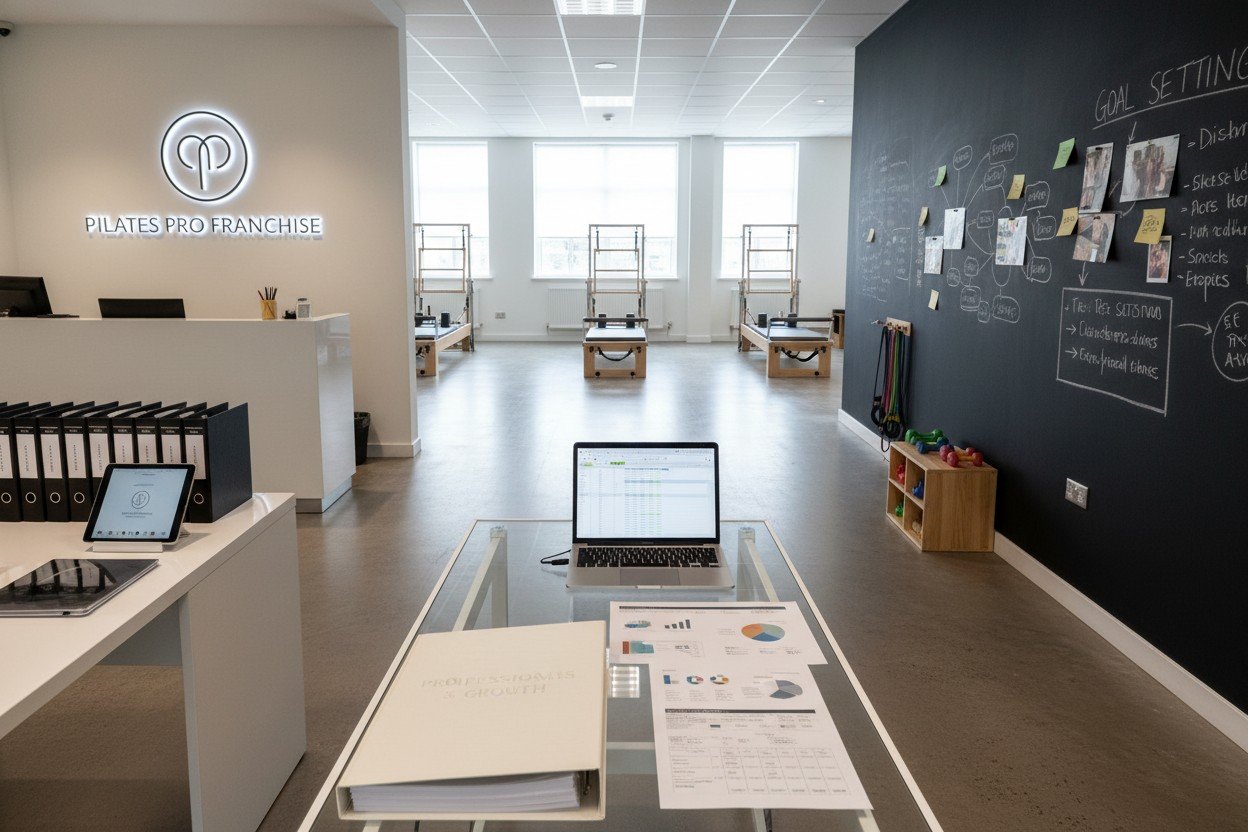
One important point often missed within these discussions is that boutique Pilates franchising is still relatively immature in the UK compared to the United States.
Historically, UK Pilates has been built largely around:
independent studios,
physiotherapy-led businesses,
owner operators,
rehabilitation specialists,
and local studio identities.
Even many highly successful operators remain independent businesses rather than franchise networks.
This matters because UK market dynamics are often very different:
catchment areas are smaller,
pricing sensitivity is often higher,
operational margins can be tighter,
VAT thresholds arrive earlier,
and owner identity still plays a major role in customer retention and studio culture.
In many cases flexibility itself becomes a competitive advantage.
Final Thoughts
I am not anti-franchise.
For some operators, the right franchise relationship may absolutely provide valuable structure, support and confidence.
But equally, many prospective studio owners may benefit from stepping back and asking themselves a more fundamental question:
“What support do I actually need in order to build a successful and sustainable business?”
Because in many cases:
consultancy,
forecasting,
operational planning,
systems,
accountability,
and strategic guidance
may provide much of what the prospective franchisee is truly seeking, while still allowing them to retain:
independence,
flexibility,
local identity,
and long-term financial control.
The UK fitness industry recently reported record membership figures:
12.2 million members and £6.5 billion in revenue.
Yet behind those numbers many studio owners still quietly face the same challenge:
retention, sustainability and operational resilience.
The studios that will matter most over the next five years are unlikely to be the businesses shouting the loudest online.
They are more likely to be the businesses quietly becoming operationally intelligent, emotionally connected and commercially resilient.
Read the Full White Paper:
Franchise vs Independent Pilates Studios: A Strategic Analysis of the UK Boutique Pilates Market
Author: Chris Onslow - Pilates Consultant
Chris Onslow, has run Pilates focussed businesses since 1998. He and his team specialise in supporting Pilates entrepreneurs and business owners. With a rich history of owning and running successful Pilates studios in the UK, and supporting others in Europe and the Middle East, Chris has broad expertise in maximising profitability and optimising operational efficiency. His agency provides top-tier advice on selecting new, pre-owned, and hireable Pilates equipment from renowned brands such as Align-Pilates, Balanced Body or Stott-Pilates/Merrithew. As the founder of Mbodies Training Academy, Chris continues to revolutionise Pilates education, offering premier online and hybrid CPD and qualification courses for Pilates apparatus instruction and special population CPD.