
What Does It Really Take to Launch a New Pilates Reformer Brand?
Why I am helping Pilates Reformers Australia bring Pravéon to Great Britain
It has probably never been easier to find a factory willing to make a Pilates Reformer with your name on it.
You can browse a catalogue of existing designs, choose an upholstery colour, add a logo, agree a quantity and receive a price that looks remarkably attractive beside established commercial brands. The product description may even say that the Reformer meets international standards.
That can be the beginning of a Pilates Studio business. It is not, by itself, the development of a credible commercial Pilates Reformer brand.
I have spent the last 30 years of my career around Pilates equipment, from selling Reformers and developing distribution networks to helping studios decide what to buy. The longer I work with apparatus, the less interested I become in how impressive a machine looks in a photograph. I want to know what happens when it is used for hours every day, when an Instructor adjusts it repeatedly between clients, when a component wears, and when a studio needs someone to resolve a problem quickly.
Those questions are part of why I have become involved in bringing Pravéon, a new commercial Pilates Reformer brand associated with Pilates Reformers Australia, to Great Britain.
An inexpensive sample is only the first question
There is nothing inherently wrong with manufacturing in China or working from an existing factory design. Many excellent products are manufactured internationally, and a good factory can be an invaluable partner. What matters is the specification, the scrutiny and the willingness to change a product that is not yet good enough.
The first risk is assuming that a supplier’s description tells you everything you need to know.
If a Reformer is advertised as suitable for commercial studios, I want to see the actual test documentation. Does it identify the same model and configuration being offered for sale? Which standard and edition was used? Does its classification cover the intended studio use, or does the documentation relate to domestic equipment? What loads and components were tested, and what has changed since the tested sample was made?
The distinction between commercial and domestic use is real. The ISO 20957 series classifies stationary training equipment for different settings, including supervised professional environments and home use. A broad statement that equipment is “tested to international standards” does not answer which classification applies to the particular machine a studio is buying.
There are other questions a photograph and a low factory price cannot settle. How well does the finish survive knocks from boxes, poles and daily adjustments? Is the paint or coating still sound after sustained use, or does it chip readily? Are the parts that bear repeated loads sufficiently robust? How does the carriage feel after months of work rather than ten minutes in a showroom? Can a worn component be identified, obtained and fitted without taking the Reformer out of service for weeks?
I would also want clarity about the right to use the design and branding. Buying a factory product does not automatically establish that every feature, name or appearance can be sold freely under a new brand. Trade marks, designs, patents and licensing arrangements call for proper checks.
None of these questions proves that a particular factory or inexpensive Reformer is deficient. They explain why a buyer — and especially someone putting their own brand on the product — needs to look well beyond the sales sheet.
The Burgess family did not start with a blank sheet of paper
Pilates Reformers Australia began as Adrian and Cheryl Burgess’s family business more than a decade ago. Their family’s account of the journey begins with using Pilates themselves, buying a Reformer for home use and then seeing an opportunity to supply equipment in Australia.
The business grew into commercial apparatus. It also developed a long relationship with Align-Pilates, distributing its products in Australasia and contributing to their development. Today, other members of the Burgess family work in the business alongside a wider team.
That history matters to me. It means Pravéon has emerged from years spent hearing what studio owners and Instructors like, what irritates them, what wears out and what happens after the sale. Experience does not automatically produce a good Reformer, but it gives a designer far better questions to ask.
The challenge was to turn those questions into a product of their own.
What should a new Reformer improve?
There are already capable commercial Reformers on the market. A new brand needs a better reason to exist than a different badge on a familiar frame.
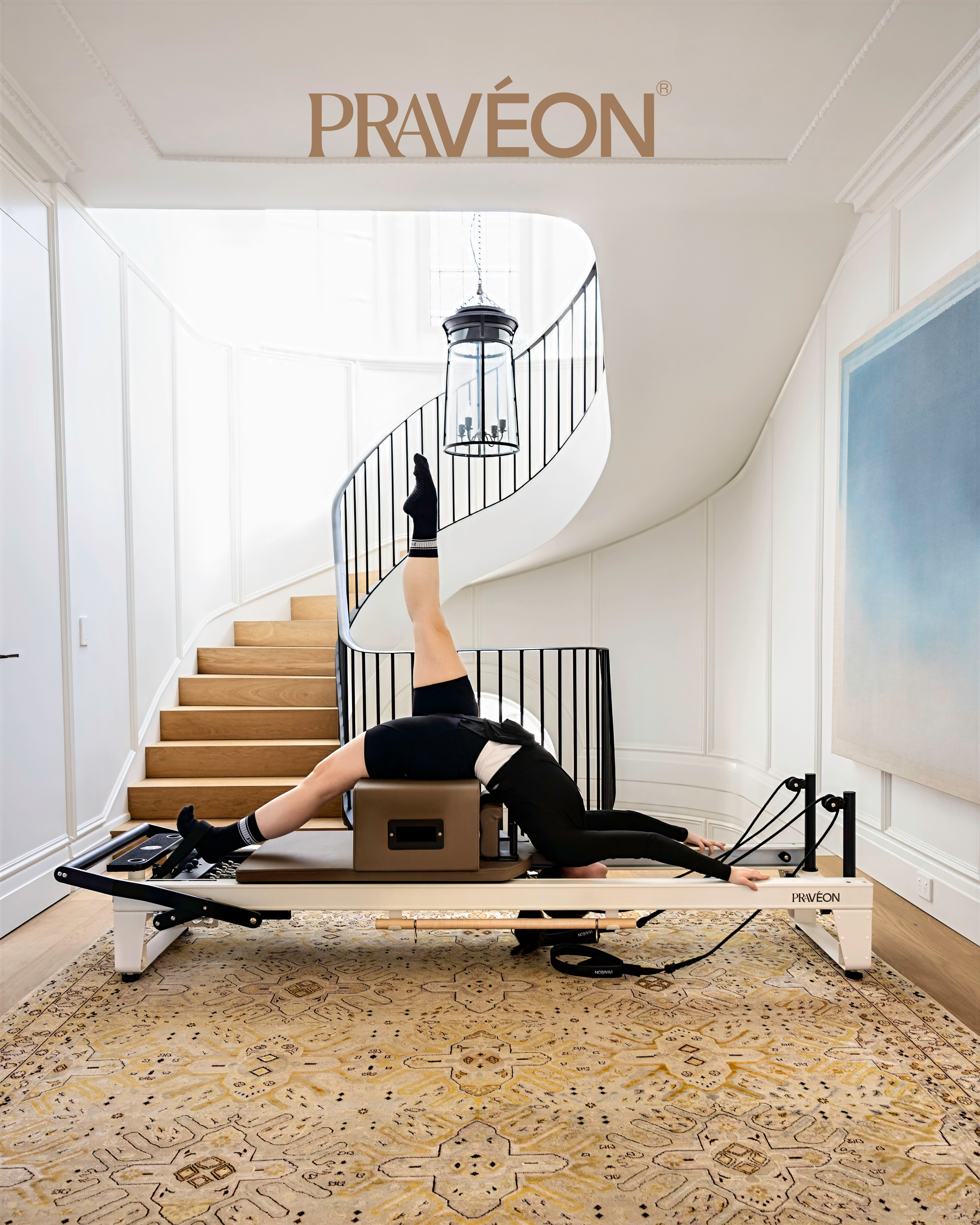
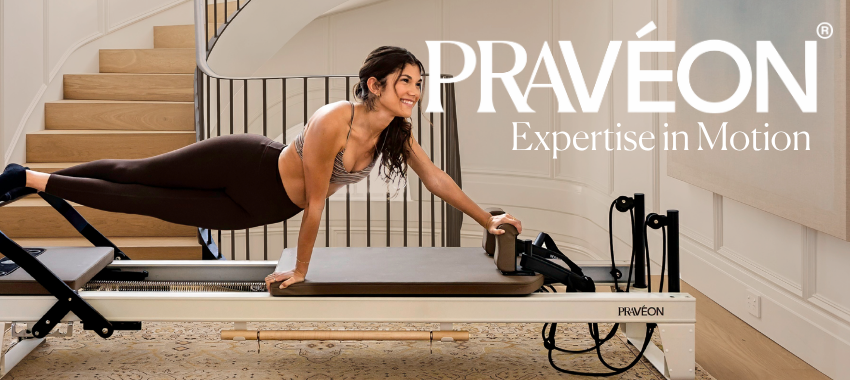
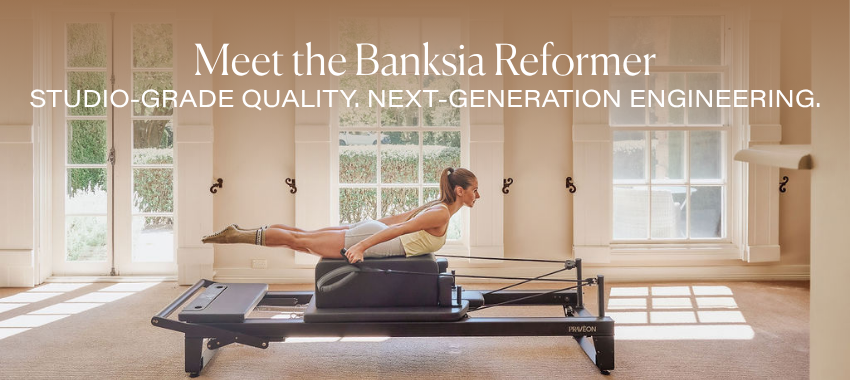
Pravéon have called their first commercial Reformer design Banksia. With Banksia, the Pravéon team has tried to preserve the recognisable feel and working proportions of a classical-style Reformer while making adjustments easier in a contemporary studio. Its published design includes a five-position footbar, an eight-wheel carriage and a rapid change patent pending integrated spring-bar arrangement that Pravéon calls the Sync Bar. The carriage is fully upholstered, and the Reformer comes in Ivory and Ebony colour schemes.
Those choices have practical as well as visual consequences. In a busy group studio, a small improvement to the speed or ease of a repeated adjustment can matter enormously. So can the way a carriage moves, the feel of the upholstery and the impression nine Reformers make when they sit together in a carefully designed room.
Appearance should be considered seriously. Studio owners invest heavily in premises, lighting, finishes and brand identity; the apparatus is often the largest and most visible part of that environment. But a beautiful machine still has to earn its place through its function and durability.
The point is not that every Banksia feature will matter equally to every Instructor. It is that the team has made deliberate choices about what it wants the Reformer to do and how it wants the equipment to feel. Those choices can be examined, tried and judged by the people who will use it.
The product is only part of a UK launch
A studio purchasing several Reformers is making a significant operational decision. The machines must arrive when needed, fit the intended space, be assembled correctly and remain usable once the studio opens.
That is the less visible part of the Pravéon launch on which I am now working in Great Britain.
The first container is on its way. Around that physical shipment, we are building the arrangements for UK stockholding, delivery and installation, spare parts, warranty handling and access to service and repair. We are also working through the information customers and Instructors need: clear product documentation, a usable Great Britain manual and education that helps a teaching team make good use of the apparatus it has bought.
I do not think a new brand earns confidence merely by promising that support will exist. It earns confidence by making the arrangements, testing how they work and dealing properly with the problems that inevitably arise when equipment is used in the real world.
This is particularly important to me because my name is associated with the UK introduction. If I advise a studio to consider a new Reformer, I want to understand not only the machine in the showroom but the system that stands behind it.
A beginning, not a conclusion
The arrival of the first Pravéon container will be a milestone after years of product thought, development and preparation by the team in Australia. It will also be the start of the brand’s most meaningful test in Great Britain.
UK Instructors will use Banksia. Studio owners will judge how it performs within their businesses. We will learn how the delivery and support arrangements work under real conditions and where they need improving.
That is how a credible equipment brand is built: through considered design, appropriate scrutiny, consistent manufacture and the willingness to remain responsible for the product after the invoice has been paid.
My consultancy contract with Pravéon goes beyond the set up of the infrastructure and covers the first two years of launch phase of the Praveon range in the UK. I remain an independent consultant when considering my client’s apparatus needs and continue to work with a variety of brands that I am confident recommending but particularly look forward to showing my clients and other studio owners and Instructors the Banksia Reformer, hearing what they think and helping Pravéon build the support its customers should expect.
The Banksia Reformer arrives in Great Britain - Opening offer
Chris Onslow
Pilates Consultant, Educator and Industry Specialist