
Why Different Pilates Reformer Brands Suit Different People

An old business acquaintance of mine, Adrian Burgess, based in Sydney Australia, has been selling Pilates Reformers into both the home and studio markets for several decades. At FIBO 2026, Europe’s premier fitness exhibition, Adrian and Cheryl his Pilates instructor wife introduced their newly developed line of Reformers under the Praveon brand.
Adrian knows of my longstanding interest in branding and market positioning and over the years we have had many discussions about the difficulties faced by companies attempting to operate multiple Pilates brands within the same marketplace. In particular we have often reflected on the unusual position occupied by Merrithew, a company that today controls three interconnected brands within the Pilates sector: Merrithew, STOTT PILATES and Align-Pilates.
Having originally introduced STOTT PILATES branded apparatus into the UK market in the early 2000’s, distributing exclusively both the equipment and the education until 2010, and subsequently becoming part of the UK team involved in the launch and positioning of Align-Pilates alongside Adrian, who joined the development team selling the equipment in Australia, I have had the unusual experience of watching these brands evolve from both inside and outside the industry.
What has fascinated me throughout is not simply the apparatus itself, but the degree to which Pilates manufacturers often misunderstand the reasons customers actually buy.
One of the greatest misconceptions within the apparatus industry is the assumption that customers are all trying to buy the “best” Reformer. In reality, different buyers purchase for entirely different reasons, different budgets, different aspirations and different environments. Not every BMW customer was ever going to buy a Mercedes, and not every Volkswagen customer secretly wanted a Bentley.
Pilates apparatus purchasing is rarely just about engineering. It is about identity, familiarity, teaching philosophy, commercial practicality and perceived value.
Traditionally the Pilates apparatus market was driven primarily by training organisations and studios. Instructors typically taught on the Reformers on which they had trained and naturally developed loyalty towards the geometry, spring feel, dimensions and movement style of those systems. A teacher who spent years training on one brand often came to regard that particular experience as “correct”.
This is one of the least discussed but most important aspects of Pilates purchasing behaviour.
Pilates instructors do not simply buy Reformers. They buy familiarity, confidence and continuity of professional identity.
A teacher who has built their teaching skills around one system often feels instinctively comfortable within that ecosystem. Over time the apparatus itself becomes embedded into their movement vocabulary and teaching style. The machine no longer feels like “a” Reformer. It feels like "the" Reformer.
This is why apparatus discussions within Pilates are often far more emotional than technical.
An instructor saying “this is the best Reformer” often really means:
“This is the Reformer on which I became good at teaching Pilates.”
When I first brought STOTT PILATES apparatus into the UK swapping my distribution loyalties away from Balanced Body: Lindsay Merrithew, co-owner of the company, was heavily focused on Balanced Body as the dominant competitor. I remember considerable concern when I positioned STOTT PILATES apparatus at a higher price point than Balanced Body within the UK market. Yet from my perspective at the time the reasoning was commercially obvious.
Much of my own background came from moving within and selling into professional sport and physiotherapy environments where metal framed Reformers were widely perceived as more clinical, more durable and more suitable for rehabilitation and athletic performance settings than traditional wooden apparatus. Whether fully justified or not, there were perceptions around hygiene, structural rigidity and long-term durability which favoured more contemporary designs.
At the same time however there was another commercial dynamic taking place within the marketplace. Many independent training schools were reluctant to use or promote STOTT apparatus because STOTT PILATES education itself was viewed as commercially aggressive. Independent Pilates education schools feared exposing their own client base to a competing education provider and to what they perceived as predatory marketing behaviour.
At that time Balanced Body did not offer education in the same aggressive integrated manner and therefore many leading independent Pilates instructor schools such as Body Control, Alan Herdman, Polestar and at that time BASI were naturally drawn towards what they viewed as politically “neutral” equipment.
Similarly Peak Pilates, whilst respected for both apparatus and education, encountered many of the same difficulties as STOTT because the brand was also associated with its own training pathways. The stronger the education ecosystem became, the harder broader equipment penetration often became outside that ecosystem.
In effect, the very strength of the STOTT and Peak educational ecosystems simultaneously limited the willingness of non-STOTT or non-Peak educators to adopt the equipment.
From my perspective at the time, the positioning therefore seemed relatively clear. STOTT apparatus occupied a premium, education-led niche with very strong loyalty inside its own ecosystem, but barriers to adoption outside it.
My own target market, professional and elite sport together with physiotherapy, was already accustomed to paying premium prices for clinical and sports conditioning apparatus and therefore the decision to pursue higher price points and stronger margins, even at the expense of wider market share, made complete commercial sense.
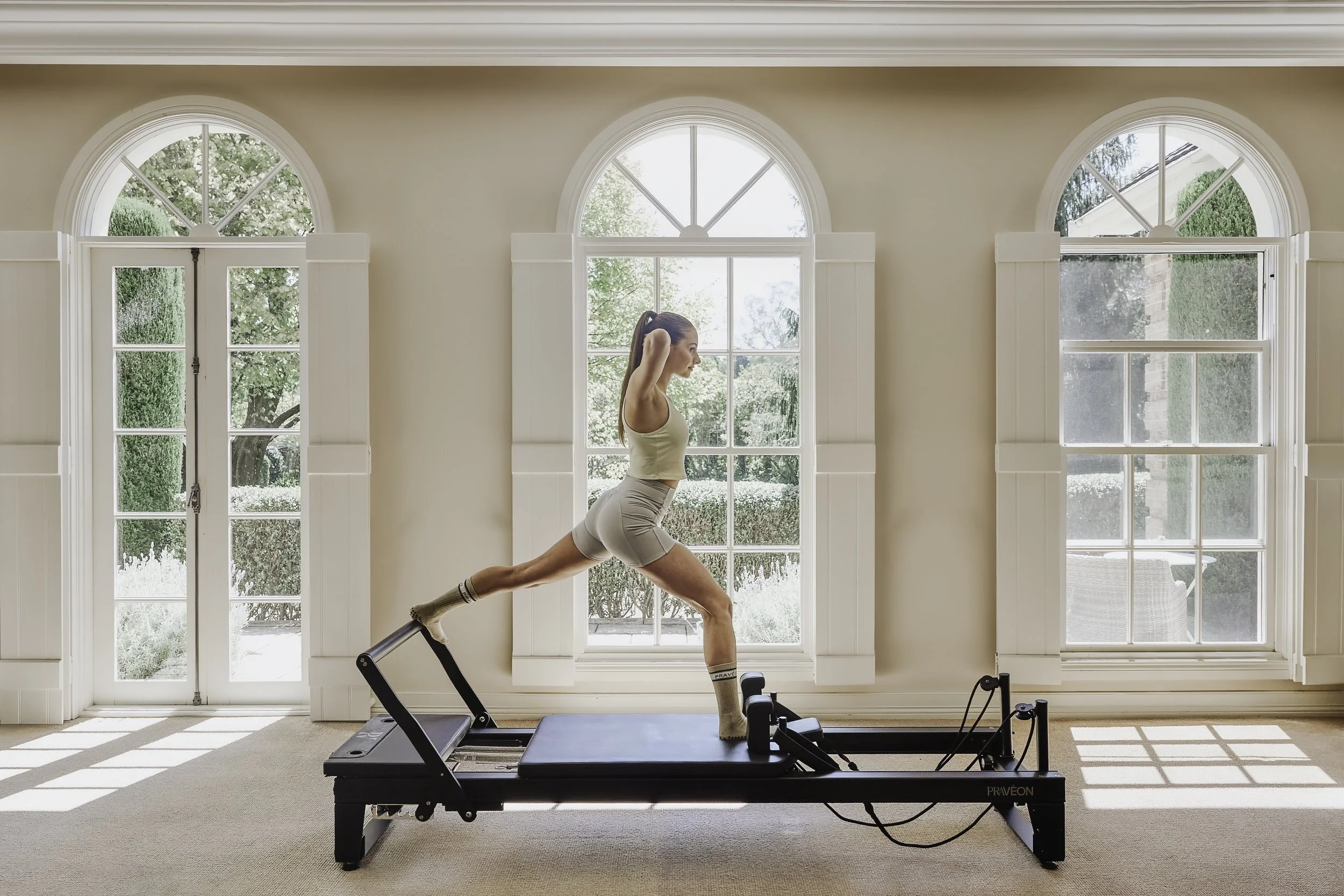
Pravéon Banksia Reformer
In hindsight however, I believe the later decision by Lindsay Merrithew to rebrand the apparatus primarily under the Merrithew name came too late to substantially reshape those perceptions within the UK market.
Roll forward roughly ten years and the launch of Align-Pilates approached the market from an entirely different direction.
Working through a deliberately non-aligned education model via Mbodies Training Academy, we consciously positioned both the Align-Pilates and Mbodies brands around the concept of “Best Value” rather than prestige.
That phrase was carefully chosen.
Best Value does not mean cheapest. Nor does it necessarily mean technically superior. It means delivering a level of functionality, aesthetics, upgradeability and professional usability which causes customers to pause before spending significantly more elsewhere.
For many studios, particularly new businesses or expanding operators, that equation was compelling.
The commercial reality of running a Pilates studio is often very different from the aspirational discussions taking place online. A studio owner fitting out ten or twelve Reformers is not simply buying apparatus. They are making a property decision, a cashflow decision, a pricing decision and often a survivability decision. In the real business world :
· Storage matters.
· Vertical storage matters.
· Upgradeable Towers matter.
· Lead times matter.
· Warranties matter.
· Frame durability matters.
· Client perception matters.
· The ability to open a studio without crippling debt matters.
Over time Align-Pilates became extraordinarily successful within the UK and now world markets because it occupied a very intelligent middle ground between premium aspiration and practical affordability. A decade after its birth and Merrithew could see they had completely lost their market position as the second largest Apparatus brand after Balanced Body in the UK to Align-Pilates and the decision was made to purchase it into he Merrithew stable.
However, over the past decade another enormous shift has taken place within the Pilates industry and one which many traditional apparatus manufacturers initially underestimated.
The home Reformer market with a desire for Professional quality machines exploded.
Initially this growth was fuelled partly by social media visibility and partly by COVID lockdown behaviour, but it rapidly evolved into something much larger. Suddenly the Pilates industry was no longer selling only to studios and instructors. It was selling directly to consumers.
This fundamentally changed the psychology of apparatus purchasing.
Home users were often not asking the same questions as studio owners or comprehensively trained instructors. They were asking:
· Will it fit in my spare room?
· Can I store it vertically?
· Does it look attractive in my home?
· Can I afford monthly payments?
· Will it arrive assembled?
· Will I actually use it?
At the same time social media created the rather surreal impression that owning a Reformer itself somehow represented a business model. We entered a period where increasingly it seemed that anything with a Reformer attached to it was suddenly considered a viable business opportunity.
This changed the market dramatically.
Pilates instructors, once the dominant growth sector for apparatus manufacturers, were in many ways overtaken by the home consumer market and now the Fitness Reformer market where there is little or no Pilates to be found. The aspirational consumer became just as commercially important as the professional teacher.
The result is that modern Pilates apparatus companies are now trying to serve multiple entirely different customer groups simultaneously:
· Classical instructors seeking authenticity and lineage.
· Contemporary educators seeking ecosystem alignment.
· Clinical practitioners seeking rehabilitation functionality.
· Boutique studios seeking aesthetics and durability.
· Franchise operators seeking scalability and return on investment.
· Home consumers seeking accessibility, affordability and lifestyle aspiration.
A company can only successfully operate multiple brands if it genuinely understands the psychology behind why each of these groups buys.
This is where I personally believe the market is becoming extremely interesting once again.
Over time, through what appears to be a gradual shift in pricing strategy, Align-Pilates seems to have drifted away from the very “Best Value Professional” positioning which originally made the brand so commercially powerful.
That creates an interesting market problem for the brand owners of Align-Pilates but a juicy opportunity for 'predators' like Praveon.
If the price differential between a value-oriented brand and a premium brand narrows too far, the customer inevitably begins asking a different question. The question stops being: “Why should I spend more?”
and instead becomes: “If I am already spending this much, why not simply buy the premium brand?”
At that point the original positioning begins to weaken.
Markets rarely tolerate empty positioning spaces for long.
This is one of the reasons why I have watched the emergence of Praveon with considerable interest.
My personal view is that there may now once again be space within the European market, and potentially parts of the North American, Australasian, Middle Eastern and African markets, for a genuinely strong Best Value positioning within commercial and home Pilates apparatus.
Less so perhaps within parts of the Far East and India where manufacturing proximity and local pricing dynamics create different purchasing behaviours, but certainly within many Western commercial markets the opportunity appears significant.
Importantly, this does not necessarily mean competing by simply being cheaper.
That is a misunderstanding frequently made by apparatus companies.
The real opportunity lies in understanding value psychology.
People do not buy Reformers in isolation. They buy business models, customer experiences, teaching identities, lifestyle aspirations and commercial survivability. The strongest apparatus brands are therefore rarely the ones with the loudest claims. They are usually the brands which most accurately understand the balance their customer is trying to achieve between functionality, aesthetics, durability, aspiration and return on investment.
From what I have seen so far, Praveon appears to understand this rather well.
Whether the brand ultimately succeeds or not remains to be seen of course. The Pilates market remains highly tribal, deeply relationship-driven and increasingly influenced by social media aspiration and consumer lifestyle marketing as much as education ecosystems and instructor familiarity.
What is becoming increasingly clear however is that many apparatus manufacturers still fundamentally misunderstand why customers choose one Reformer over another. This becomes particularly problematic when companies own multiple differently targeted brands and then find themselves becoming nervous about distributors selling those brands side by side for fear that direct comparison may expose uncomfortable questions around value, positioning or differentiation.
At that point the issue is no longer engineering, It becomes psychology.
And this is perhaps the most important lesson within the entire Pilates apparatus industry.
Much of brand positioning is driven less by objective product superiority and far more by customer perception, ecosystem loyalty, familiarity, aspiration and commercial storytelling.
Until a company truly understands why its customers buy, it is very difficult for that company to understand how its brands should be positioned.
Author: Chris Onslow - Pilates Consultant
Chris Onslow, has run Pilates focussed businesses since 1998. He and his team specialise in supporting Pilates entrepreneurs and business owners. With a rich history of owning and running successful Pilates studios in the UK, and supporting others in Europe and the Middle East, Chris has broad expertise in maximising profitability and optimising operational efficiency. His agency provides top-tier advice on selecting new, pre-owned, and hireable Pilates equipment from renowned brands such as Align-Pilates, Balanced Body or Stott-Pilates/Merrithew. As the founder of Mbodies Training Academy, Chris continues to revolutionise Pilates education, offering premier online and hybrid CPD and qualification courses for Pilates apparatus instruction and special population CPD.